
Relaywardens Wiki: Units, Crystals and Stage Flow
Relaywardens in one page: the eight units and their crystal costs, stage crystal caps, ability slots, finish-zone rules and where the trophies sit.
Relaywardens is a squad-building action roguelite: you drop a mercenary crew onto an alien planet, spend crystals on units and automatic abilities between stages, then walk the squad into a finish zone while the horde tries to eat it. The whole loop fits on one screen, but the numbers behind it are stingy — 30 leadership slots, eight hireable units, and a crystal meter that caps mid-stage whether you are ready or not. Start with the stage-by-stage walkthrough→ if you are already stuck, or read this page as the map of the systems.
The game launched on PlayStation 5 (PPSA40751) and Nintendo Switch (70010000144145) on 26 November 2026 at $9.99. A Steam page exists for PC (app 5373640) but still reads "Coming soon", so everything below is written from the console build that shipped today.
What you actually control
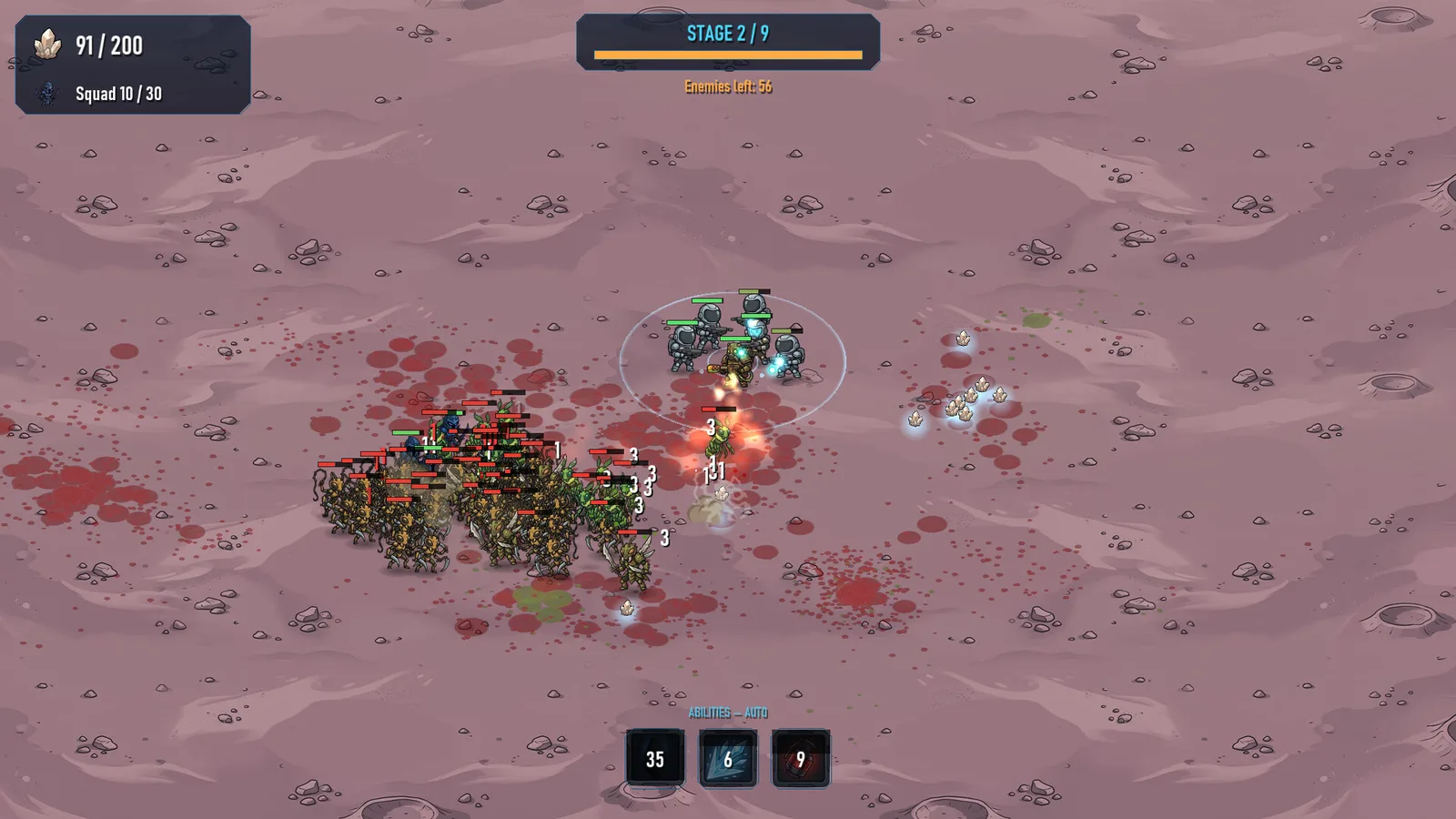
You control the squad, not the shots. Units pick targets and fire on their own; abilities fire on their own once slotted. Your inputs are movement, unit placement in the shop, and the order you buy things. That sounds thin until the first stage where the horde outnumbers you 174 to 12 — the counter is on screen — and the only lever left is where the squad stands.
Three decisions repeat every stage:
- Hire or hold. Each unit has a crystal price and, for the expensive ones, a hard cap.
- Take the free upgrade or reroll the shop. The free pick lasts until the end of the level and applies to units hired later, so late purchases inherit it.
- Push for the finish zone or farm kills. Crystals come from kills, but the stage ends when the squad reaches the zone, not when the field is empty.
That third point is the one new players get wrong. You do not need to clear a stage. The HUD keeps an "Enemies left" count, and it stays high when the clear banner appears. The finish zone rules→ go deeper, but the short version is: kills are income, the zone is the exit.
The eight units and what they cost
Prices below are the shop values shown in the retail build, in crystals:
| Unit | Cost | Cap | Slot note |
|---|---|---|---|
| Warden | 10 | — | cheapest body, first hire |
| Rifleman | 15 | — | ranged filler |
| Rammer | 20 | — | melee chaff |
| Shotgunner | 30 | — | 6 pellets, 35° spread |
| Sniper | 30 | — | long-range pick |
| Hammerguard | 80 | x2 | premium melee |
| Juggernaut | 100 | x2 | premium bruiser |
| Flamer | 150 | x4 | most expensive card |
Only the Shotgunner showed its full stat card in the recorded run: Health 45, Damage 1x6, Attacks/s 0.5, Range 450, with six pellets inside a 35-degree cone. Everything else stayed behind an unread tooltip, so I will not invent damage numbers for them. What the table does tell you is the price ladder: the first four hires cost less than a single Flamer, and the two capped units cost more than an entire opening squad.
That shape drives the unit tier list→: cheap bodies win the early stages because leadership, not crystals, is the binding limit; the 80+ cards only earn their price once your crystal storage can absorb a bad shop.
Crystals: income, cap and the storage upgrade
Crystals are the only currency. You earn them from kills during a stage and spend them on the clear screen before the next landing, so the number you walk in with is the number the shop sees.
The meter reads current/cap, and the cap is per stage: I have seen 33/300 on the first planet, 22/350 and 244/350 later, then 44/600 at the stage 9 boss and 314/650 in the final third. The denominator is the storage ceiling, not your total wealth. Storage +50 costs 10 crystals and stacks up to ten times, which is the cheapest permanent upgrade in the game and the first thing I would buy after a stable opening.
Ten crystals for +50 ceiling pays for itself the first time a kill wave would have overflowed. The shop offers it from the first clear screen, and it never stops being useful.
The crystal economy guide→ breaks down how much a stage actually pays out, but the practical rule is simple: if your meter is pinned at the cap when the clear screen opens, you left crystals on the floor.
Abilities are automatic, and that is the build
Abilities sit in a strip along the bottom of the HUD with a cooldown timer under each icon and an AUTO toggle. You do not cast them. You choose them, level them, and then trust the timers.
Early runs show four slots. By the stage 9 fortress the strip had eight, all ticking. Ability cards cost 35–60 crystals in the shop (Searing aura 35, Shields 35, Sticky ground 45, Tornado 55, Energy shield 60) and the trailer shows the free pick screen offering Rotating Blades, Energy Shield, Reinforcement and Tornado before the first landing. Levels compound: Rotating Blades at Lv 3 in the trailer hits noticeably harder than the Lv 1 version.
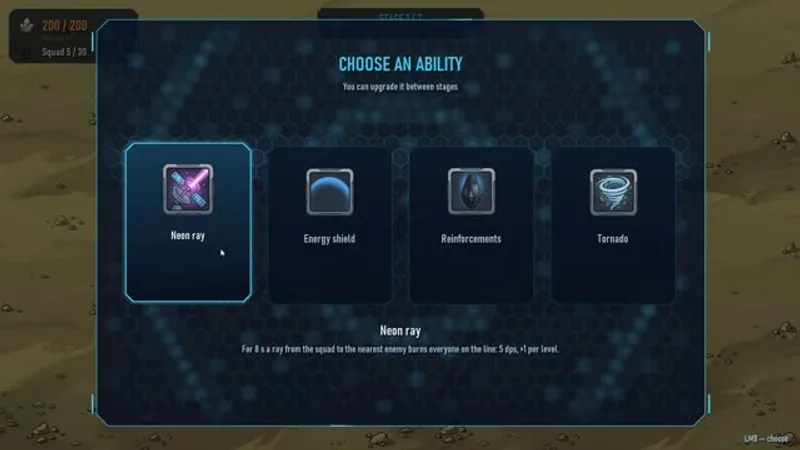
Because abilities fire themselves, a "build" in Relaywardens is mostly a shopping list: which passives you stack and which units inherit the free damage buff. The abilities guide→ covers slot count and level-ups; the best build page→ covers the order I would buy them.
Stage counts are per planet
The HUD prints STAGE n/N, and N changes with the planet: 9 on the jungle opener, 7 on the purple world, 5 on a short rock planet, 18 on a later one. So "how many levels" has two answers — nine campaign levels, each made of 5–18 stages. The planets and stages page→ lists every denominator I could confirm, and the walkthrough→ walks the first planet stage by stage.
Trophies: 31, and most of them are kills
The PlayStation list has 31 trophies: one platinum, seven gold, five silver and eighteen bronze. Nine are level completions (Into the Fray through The Final Relay), eight are "recruit the X" for each unit, and thirteen are kill milestones running from 500 to 100,000. The 100,000-kill trophy is the long tail; the recruit trophies are the ones you can mop up deliberately. Full names and requirements are in the achievements list→.
Nothing in the list asks for a no-hit run or a specific build. If you finish the campaign and recruit all eight units, the remaining work is repeating stages for kills — the 100,000 milestone alone is several full clears.
Platform notes
Switch and PS5 versions are content-identical as far as the store listings and my first runs show. The Switch file is about 754 MB, one player, ESRB E10+ for fantasy violence and mild blood. Steam lists Windows 10, a 2 GHz dual-core, 2 GB of RAM and 150 MB of storage — a very light footprint for a game that puts 170+ enemies on screen.
Official source: Steam store page ↗, Nintendo eShop listing ↗, PlayStation Store ↗
FAQ
Is Relaywardens a roguelite or a tower defense game? It is a roguelite run structure wrapped around squad management. You build an army between stages, fight real-time waves, and restart the planet on a loss with upgrades reset. There are no lanes or towers to place.
Does Relaywardens have multiplayer or co-op? No. Both store listings tag it single-player only, and Steam lists no online co-op or PvP features.
Is the game finished on Switch, or is it early access? The console versions are full releases sold at $9.99. The PC version is the one still marked "Coming soon" on Steam.